AI Is Not About Apps. And It Was Never About Prompts.

Insights from Vishwanath Akuthota
Deep Tech (AI & Cybersecurity) | Founder, Dr. Pinnacle
AI Is Not About Apps. And It Was Never About Prompts.
I was watching a lecture from MIT recently. What stood out wasn’t the content itself, but the way it approached something most modern AI conversations avoid—first principles.
Instead of starting with models or applications, it started with computation.
Not in the mechanical sense, but in the philosophical sense.
What does it actually mean to compute something?
When we say a system “evaluates” an expression, what is being transformed, and what remains invariant? Where does meaning come from—does the system produce it, or do we project it?
These are not academic questions. They are structural questions. And the absence of clear answers to them is exactly why so much of today’s AI discourse feels inflated.
We’ve all seen the flashy demos. A line of text becomes a photorealistic video; a simple question turns into a fully coded website. In the gold rush of the 2020s, the world has become obsessed with the surface of the water—the apps, the chatbots, and the "magic" prompts that make them dance.
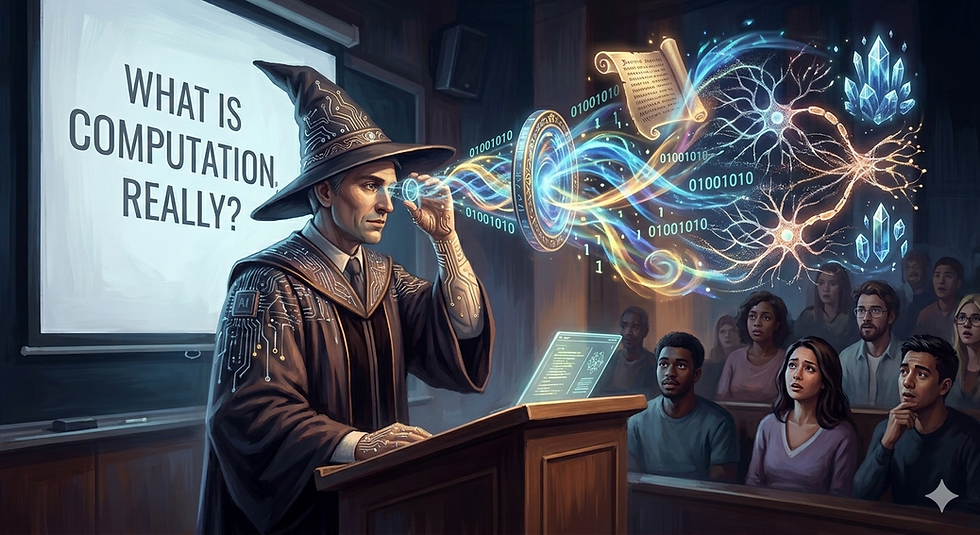
But there is a quiet, almost subversive movement happening in the halls of places like MIT. It’s a movement that suggests we are looking at the wrong thing. While everyone else is arguing over which AI app is better, the real builders are putting on wizard hats and asking a much stranger question:
What is computation, really?
If you want to survive the AI revolution, you need to stop thinking like a user and start thinking like a "wizard." Here is why the foundations of AI matter infinitely more than the tools you’re currently using.
The "App" Trap
Imagine it’s the year 1900. The internal combustion engine has just been invented. You have two types of people:
The Driver: They learn how to steer, how to brake, and where to put the fuel. They are useful immediately.
The Engineer: They understand thermodynamics, torque, and how a spark creates a controlled explosion.
When the car breaks down, or when society needs to transition from cars to airplanes, the driver is stuck. The engineer, however, understands the principle of power. They can build the next thing because they aren't tied to the steering wheel; they are tied to the physics.
Right now, most people are "AI Drivers." They are mastering "Prompt Engineering," which is often just a fancy way of saying "learning how to talk to a specific piece of software." But software changes every six months. If your entire value as a professional is based on knowing the "secret sauce" prompt for ChatGPT-4o, what happens when ChatGPT-5 makes that prompt irrelevant?
Putting on the Wizard Hat
In that famous MIT lecture (a nod to the legendary Structure and Interpretation of Computer Programs), the professor famously dons a wizard hat. It’s a bit of academic theater, but the point is profound: Coding is like spell-casting.
In a "spell," you have two main ingredients:
Eval (Evaluate): Looking at a set of rules and figuring out what they mean.
Apply: Taking those rules and actually doing something with them.
Everything you see in AI—from the simplest calculator to the most complex neural network—is just a massive, high-speed game of "Eval and Apply." When we strip away the marketing jargon, we find that AI isn't "thinking." It is computing. Understanding this is like seeing the code in The Matrix. Once you realize that an AI "agent" doesn't actually have "agency" (it’s just a loop of math deciding the next most likely action), you stop being intimidated by it. You stop treating it like a magic black box and start treating it like a tool you can disassemble and improve.
Why the Labels We Use Are Lying to Us
We are currently living through a massive linguistic misunderstanding. We use human words to describe machine processes, and it confuses our intuition:
The Human Word | The Machine Reality |
|---|---|
Intelligence | Mathematical pattern matching at a massive scale. |
Learning | Adjusting mathematical weights to reduce error. |
Agency | A set of "If/Then" instructions executing in a sequence. |
Why does this distinction matter for a layman? Because if you think the machine is "smart" like a human, you will trust it when you shouldn't. If you understand that it is a mathematical engine, you will know exactly where it is likely to fail.
The people who build the future aren't the ones who treat AI like a colleague; they are the ones who understand it is a highly sophisticated mirror of data.
The Three Pillars of a Lasting AI Career
If you want to be in the group that builds the future rather than the group that just reposts it, you need to focus on three things that don't change:
1. Abstraction
This is the ability to take a complex problem and find the simple pattern underneath it. In AI, this means knowing how to take a messy human task (like "sorting insurance claims") and turning it into a logical flow that a machine can handle. Tools change; the ability to simplify never does.
2. Evaluation
This is the "Wizard's Eye." It’s the ability to look at what a machine produced and understand why it produced it. Was the data biased? Was the logic flawed? Mastering evaluation makes you the "adult in the room" when the AI starts hallucinating.
3. Computation
You don't need to be a math genius, but you should understand how machines process information. When you understand the "pipes" through which the data flows, you stop being a consumer and start being an architect.
Real Life: The Chef vs. The Microwave User
Think of AI like a high-end, automated kitchen.
The Tool-User knows which buttons to press to get a medium-rare steak. They are great as long as the machine works perfectly.
The Foundation-Builder understands heat transfer, protein structures, and flavor profiles.
If the power goes out, or if a customer wants a dish the machine wasn't programmed for, the Chef is the only one who can deliver. In the AI world, we are currently flooded with "Microwave Users." They can generate an image or a blog post, but they don't know the "flavor profiles" of the data they are using. They can’t fix the output when it tastes "off."
The Verdict: What Matters More?
Mastering the tools is necessary for survival today. You need to know how to use AI to keep up with the pace of work.
But understanding the foundations is necessary for sovereignty tomorrow.
The "surface-level" crowd is currently winning the race for attention. They have the best "Top 10 AI Tools You Can't Miss" threads. But beneath the surface, the "Wizard" crowd is building the infrastructure those tools run on.
The tools are the "what." The foundations are the "how" and the "why."
Don't just learn to prompt. Learn to understand the "Eval and Apply" happening behind the screen. Because in a world where everyone can use the magic wand, the only person who stays valuable is the one who knows how the wand was carved.
The Future Belongs to the Architects of Logic
At Dr.Pinnacle, we don’t just track the latest AI buzzwords; we deconstruct the machinery behind them. We believe that true security and innovation in the age of AI don’t come from following a manual—they come from understanding the "spell" being cast.
While others are racing to buy the latest tools, we help organizations build adaptive resilience by mastering the foundations of AI literacy and cybersecurity. We specialize in moving you past surface-level fluency and into a state of sovereign AI ownership.
Ready to stop chasing the hype and start building the backbone?
Master your "Signal": Learn how to separate the noise of new apps from the core logic of computation.
Own your Security: Implement AI-driven defenses that understand the why, not just the what.
Build with DrPinnacle: Join the leaders who aren't just reposting the future—they’re architecting it.


Comments